
In recent years, as global trade has been reshaped, the logistics sector has evolved from an activity focused solely on transporting freight into a strategic element that directly affects countries' competitiveness. Disruptions in supply chains, increasing sustainability expectations, and changing customer demands are driving companies to develop more resilient, more predictable, and more environmentally friendly logistics models.
At the center of this transformation are rail and intermodal transport.
Having remained in the shadow of road transport for many years, rail transport is now regaining strategic importance in terms of reducing carbon emissions, capacity management, operational reliability, and international connectivity. Particularly with the European Green Deal, sustainability in the logistics sector has become not only an environmental preference but also a commercial necessity.
However, an important question arises:
Is rail transport truly ready to assume a decisive role in the future of the global logistics system, or does it still face structural barriers that need to be overcome?
The answer to this question lies not only in infrastructure investments but also in border crossings, terminals, international coordination, digitalization, and integration between transport modes.
From Türkiye's perspective, the issue carries even greater significance. Positioned as a strategic bridge between Europe and Asia, our country will be able to generate greater added value in international supply chains to the extent that it develops its rail and intermodal systems alongside its strong road network.
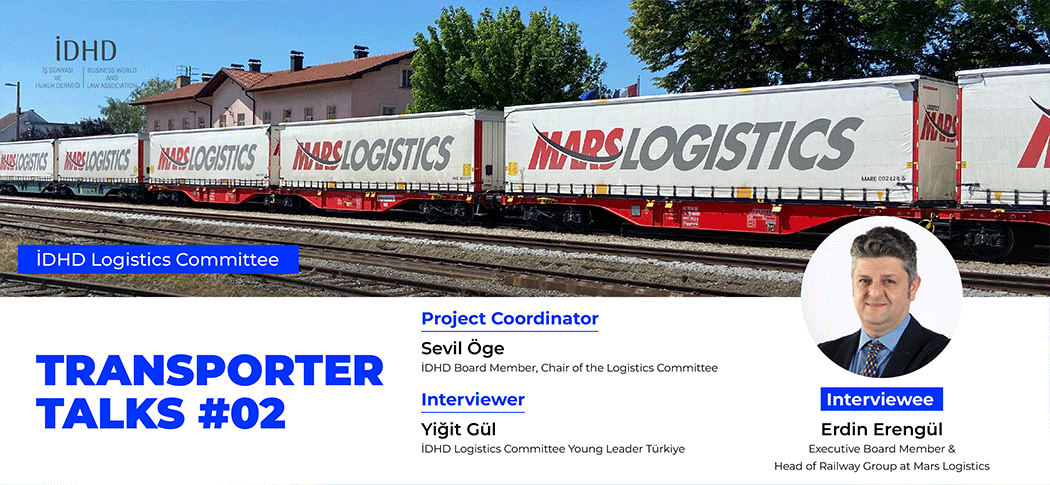
In the second installment of our interview series, which I conduct as the Türkiye Young Leader of the Logistics Committee of the Business and Law Association, we spoke with Mr. Erdin Erengül, Executive Board Member and Head of Railway Group at Mars Logistics, one of Türkiye's leading organizations in intermodal transport, about the future of Türkiye–Europe rail transport, changing customer expectations, the effects of digitalization on the sector, and Türkiye's goal of becoming a logistics hub.
Today, as sustainability goals become increasingly important, rail transport is once again becoming a focus of investment in many countries. Nevertheless, industry representatives assess the development of rail transport not only through the construction of new lines but also through the comprehensive integration of logistics networks.
At this point, the fundamental issue is no longer simply transporting freight from one point to another.
The real challenge is to connect different transport modes, different countries, and different operational systems seamlessly.
The future of Türkiye's logistics connections with Europe also appears to depend largely on this integration capability.
This raises an important question:
Can Türkiye become a stronger logistics hub in global supply chains by strengthening its rail integration with Europe?
In this interview with Mr. Erdin Erengül, Executive Board Member and Head of Railway Group at Mars Logistics, we examined the future of rail transport, the rise of intermodal logistics models, the impact of digitalization on operations, and Türkiye's strategic position in European corridors from an industry perspective.
In your opinion, what are the most significant opportunities and critical obstacles in the coming period in terms of increasing the share of rail transport in Türkiye's trade with Europe? What role does Mars Logistics play in this transformation of rail transport?
Erdin Erengül: One of the most significant opportunities in the coming period for increasing the share of rail transport in Türkiye's trade with Europe is the growing need for sustainable logistics solutions and alternative transport models in supply chains. Companies are now focusing not only on costs and delivery times but also on operational reliability, supply chain resilience, and environmental impact. Rail transport stands out as a strong alternative that complements road transport, particularly for regular and high-volume freight flows.
Nevertheless, for rail transport to become more widely used, border crossing procedures need to be improved, infrastructure and terminal capacities need to be increased, and operational compatibility between the railway systems of different countries needs to be strengthened. Service frequency, the predictability of transit times, and end-to-end service quality also directly influence customer preferences.
At Mars Logistics, we regard rail transport as one of the strategic elements of our sustainable and integrated logistics approach. We continue our investments in rail and intermodal transport to strengthen our connections between Türkiye and Europe and offer our customers more transport alternatives. Preventing approximately 310,000 tons of carbon emissions through the 200,000 trips we operated on our Halkalı–Bettembourg and Trieste–Bettembourg routes between 2012 and 2025 is one of the tangible results of this approach. We view the development of rail transport not merely as a change in transport mode but as a strategic transformation that will enhance Türkiye's competitiveness in international logistics.
Within the framework of an intermodal model in which road, rail, and maritime transport complement one another, how do you assess customers' interest in and demand for rail transport solutions?
Erdin Erengül: We observe that customers' interest in rail transport is gaining importance in line with sustainability expectations and the need for alternative solutions in supply chains. Nevertheless, what matters to customers is not merely the use of rail transport, but also total logistics costs, delivery times, access to capacity, flexibility, and service reliability.
Intermodal transport provides a significant advantage in this regard. Combining the flexibility of road transport with the long-distance carrying capacity of rail transport and the alternatives offered by maritime transport where needed enables customers to establish more balanced and resilient supply chains. Particularly for companies with regular freight flows between Türkiye and Europe, this model offers significant opportunities in terms of optimizing costs, using transport capacity more efficiently, and reducing environmental impact.
At Mars Logistics, we regard different transport modes as complementary elements rather than alternatives to one another. Our aim is to establish the right balance between cost, speed, reliability, and sustainability while developing a transport model suited to each customer's needs and the characteristics of the freight. We believe that, in the future of intermodal transport, logistics providers capable of managing different modes in an integrated, end-to-end manner will create greater value.
In terms of developing the rail connection between Türkiye and Europe, which areas do you think should be prioritized regarding border crossings, capacity, infrastructure, and operational sustainability? How do you assess the impact of these developments on the Middle Corridor and Türkiye's connections with Europe?
Erdin Erengül: We believe that strengthening the rail connection between Türkiye and Europe requires a primary focus on infrastructure capacity, border crossings, connections between terminals, and the coordination of international operations. The competitiveness of rail transport is determined not only by the physical capacity of railway lines but also by the ability to transport freight seamlessly and predictably from its point of origin to its destination.
In this regard, simplifying customs and documentation procedures at border crossings, harmonizing operational practices across different countries, developing terminal capacities, and conducting service planning more effectively are of great importance. In addition, optimizing locomotive and wagon utilization, increasing return loads, and reducing uncertainties in transit times are among the measures that will support operational sustainability.
The Middle Corridor has the potential to strengthen Türkiye's strategic position in logistics connections between Asia and Europe. However, for this potential to translate into a lasting commercial advantage, it is not sufficient for the corridor merely to offer an alternative route; it must establish a competitive structure in terms of capacity, transit time, cost, and service reliability.
Strengthening Türkiye's integration with the European railway network could support the Middle Corridor's access to Europe while also enhancing our country's role in international supply chains. To achieve this, effectively connecting ports, logistics centers, and intermodal terminals is just as important as developing railway infrastructure. Coordinated investments by the public and private sectors, cross-border cooperation, and long-term planning will support Türkiye's goal of becoming a regional logistics hub.
Technologies such as digitalization, real-time tracking, and data analytics are expected to significantly transform business models in the future of rail transport. In your opinion, which areas will be most affected by these technologies? How do you assess the relationship between rail transport and digitalization today?
Erdin Erengül: The areas where digitalization will have the greatest impact on rail transport include real-time tracking, operational planning, capacity management, and data-driven decision-making processes. The ability to monitor the location of freight and its estimated time of arrival, identify potential delays in advance, and inform customers at the right time directly improves service quality.
Data analytics and forecasting technologies can contribute to more efficient utilization of railway line and terminal capacities, improved equipment planning, and the control of operational costs. Digital document management and data integration between systems also help simplify processes by accelerating information flows in international transport. We believe that, in the medium and long term, artificial intelligence-supported planning applications will gain greater importance in demand forecasting, route optimization, and operational risk management.
Today, we view the relationship between digitalization and rail transport as extending beyond technology being a tool subsequently added to operations; rather, we regard it as a fundamental element shaping the service model. Nevertheless, achieving real-time and end-to-end visibility requires integration not only within logistics companies but also between the systems of carriers, terminals, customs authorities, and other stakeholders.
For Mars Logistics, digitalization is important not only for providing our customers with a more transparent, predictable, and measurable service but also for improving resource utilization and increasing operational efficiency. In the coming period, the joint development of digital infrastructure and physical logistics networks will be one of the key factors enhancing the competitiveness of rail transport.
As Mars Logistics, which routes, destinations, and intermodal solutions are you prioritizing for your rail operations in the coming period? What kind of vision do you think the industry should adopt to further strengthen Türkiye's logistics network?
Erdin Erengül: At Mars Logistics, we position rail and intermodal transport as a strategic priority and continue our investments to strengthen our logistics connections between Türkiye and Europe. As an important part of this approach, we launched our Halkalı–Luxembourg and Kartepe–Duisburg routes in 2026. While our Halkalı–Luxembourg route provides access to delivery regions in France, Belgium, and western Germany, our Kartepe–Duisburg route has strengthened our transport solutions to Germany's Ruhr region through a connection via the Marmaray crossing. Both routes are planned with weekly round-trip services and operate with a target delivery time of eight days.
In addition to these new connections, we manage an integrated logistics network between Türkiye and Europe through our Halkalı–Bettembourg, Trieste–Bettembourg, Halkalı–Kolin, Halkalı–Craiova, and Halkalı–Budapest routes. Furthermore, our commencement of rail transport for finished vehicles between Romania and Türkiye, together with our wagon investments in this area, demonstrates our approach to developing rail solutions for different types of freight. In the coming period, we will focus on providing intermodal solutions tailored to our customers' changing needs while improving the efficiency, capacity utilization, and connectivity options of our routes.
We believe that, as an industry, we need to act with a long-term and comprehensive vision to strengthen Türkiye's logistics network. Investments in railway infrastructure, the development of rail connections to ports and logistics centers, the facilitation of border crossings, and integration between digital systems should be the fundamental components of this vision. In addition, strengthening public-private sector cooperation, ensuring the effective use of international railway corridors, and expanding policies that support sustainable transport are also of critical importance.
To transform Türkiye's geographical position into a lasting logistics advantage, we must aim not merely to be a transit country but to become a reliable and integrated logistics hub that creates added value in international supply chains. At Mars Logistics, we will continue to be part of this transformation by developing our rail investments, intermodal network, and operational capabilities. Our priority is to strengthen Türkiye's position in the European logistics network while providing our customers with more efficient, predictable, and sustainable transport solutions.
The transformation taking place in the logistics sector can no longer be explained solely by new routes or new means of transport. Today, competitive advantage is shaped by the ability to integrate transport modes, increase operational visibility, and place sustainable solutions at the center of business models.
One of the most important elements of this transformation is rail transport. However, the future of rail transport depends not only on the opening of new lines but also on comprehensive development extending from border crossings and terminal operations to digital systems and international coordination.
The approach adopted by Mars Logistics also reflects the fundamental logic of this transformation. Viewing rail, road, and maritime transport not as alternatives to one another but as parts of a complementary ecosystem emerges as one of the most important requirements of the future logistics structure.
At this point, the most critical reality is as follows:
The future of logistics will be determined not only by transport capacity but also by the ability to manage integration between modes, data, and sustainability.
Strengthening Türkiye's rail connections with Europe, increasing its intermodal investments, and accelerating digital transformation will contribute to our country becoming not merely a transit point but an indispensable logistics hub in global supply chains.
I hope that this interview will help industry professionals, decision-makers, and young people aspiring to careers in logistics better understand the changing role of rail transport and gain new perspectives on Türkiye's logistics future.
Project Coordinator:
Sevil Öge - İDHD Board Member, Chair of the Logistics Committee
Interviewer:
Yiğit Gül - İDHD Logistics Committee Young Leader Türkiye
Interviewee:
Erdin Erengül - Executive Board Member & Head of Railway Group at Mars Logistics