
In recent years, global trade has not simply changed direction; it has been redefined. At a time when post-pandemic vulnerabilities persist and geopolitical risks are increasing, logistics is no longer merely an operational function; it has become an area of strategic decision-making.
Today, the key question facing the sector is no longer which route is the shortest or the least expensive, but rather: what does it take to build the most resilient, flexible and manageable logistics system?
This search has brought intermodal transport and alternative corridors to the forefront. The Middle Corridor, in particular, has attracted growing attention in recent years and emerged as an important option for Eurasian transport.
There is, however, an important distinction to make. Although the Middle Corridor is often viewed solely as an infrastructure project, the reality on the ground extends far beyond infrastructure. The corridor represents a complex structure that brings together different countries, systems and operational dynamics. The issue, therefore, is not simply infrastructure, but how this structure is managed, coordinated and operated.
Türkiye, meanwhile, is not merely part of this system; with the right strategy, it can position itself at the centre of this multilayered structure.
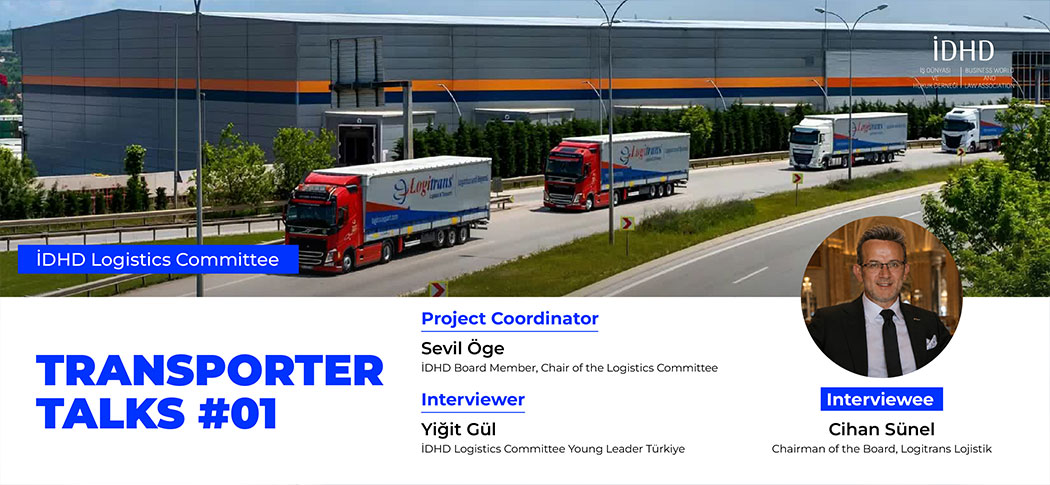
Against this backdrop, in the first of this interview series launched as part of my role as Türkiye’s Young Leader of the Logistics Committee of the Business World and Law Association (İDHD), we spoke with Mr. Cihan Sünel, Chairman of the Board of Logitrans Lojistik, about logistics management in times of crisis, the true potential of intermodal transport and the operational reality of the Middle Corridor.
Global logistics networks have undergone significant restructuring in recent years. The vulnerabilities exposed in traditional transport routes have led companies to move away from decisions based solely on cost and speed, bringing risk management, route diversification and operational resilience to the forefront instead.
In this environment, the Middle Corridor has attracted increasing attention amid growing geopolitical uncertainty and the search for alternatives. However, as noted in the Asian Development Bank’s (ADB) CAREC Middle Corridor Assessment, although transport volumes along the corridor have increased in recent years, its share of Eurasian trade flows remains at a relatively low level. This indicates that the corridor remains limited in scale within Eurasian transport.
This raises an important question:
Is the Middle Corridor truly a new logistics revolution, or is its potential yet to reach operational maturity?
In our interview with Mr. Cihan Sünel, Chairman of the Board of Logitrans Lojistik, we discussed Türkiye’s strong position in road transport, the realities of intermodal transport on the ground, and the strengths and weaknesses of the Middle Corridor from an operational perspective.
1. How have recent geopolitical developments affected route and transit-time management in Türkiye’s international road transport sector?Cihan Sünel: The Russia-Ukraine War, security challenges in the Middle East, the crises affecting the Red Sea and Suez route, and regional political developments in recent years have led to significant changes in international transport corridors. Türkiye’s logistics sector has also been directly affected by these developments. In road transport in particular, the increasing difficulty of using certain traditional routes has accelerated the shift towards alternative routes, resulting in longer transit times, higher costs and the need for more dynamic operational planning. At the same time, Türkiye’s position as a natural logistics hub between Europe, the Caucasus, Central Asia and the Middle East has further increased its strategic importance during periods of crisis. Thanks to its operational flexibility and ability to adapt rapidly, the Turkish transport sector has demonstrated considerable resilience throughout this period.
2. How do you assess the role of intermodal transport and the Middle Corridor in this context?Cihan Sünel: Geopolitical developments have shown that intermodal transport is no longer simply an alternative but has become a strategic necessity. Intermodal systems combining road, rail and maritime transport both reduce operational risks and contribute to sustainable logistics objectives. In this context, the Middle Corridor is not merely a transit route for Türkiye; it is also a strategic corridor that will shape the future of regional trade. Türkiye’s central location along this route, stretching from China to Europe, gives it a significant advantage. However, for the Middle Corridor to reach its full potential, it is crucial to accelerate border crossings, strengthen railway infrastructure, expand the use of digital customs procedures and enhance coordination between countries.
3. To what extent has alternative route planning become part of your operations, and what strategies has your company developed in response?Cihan Sünel: Alternative route planning is no longer a practice reserved for exceptional circumstances; it has become an integral part of the sector’s day-to-day operational management. Rather than relying on a single route, transport companies are now assessing multiple corridors simultaneously, making greater use of intermodal solutions and managing their operations in real time through digital tracking systems. At Logitrans Lojistik, we work closely with public authorities and international bodies to address the border-crossing challenges faced by our members, as well as issues relating to transit documents and transit quotas, and to support the development of new corridors.
4. Have you seen a change in customer demand, particularly when it comes to delivery times, cost sensitivity and the shift towards alternative modes of transport?Cihan Sünel: Absolutely.
While cost used to be the primary consideration, today delivery reliability, operational continuity and risk management have become just as important as cost. Shippers increasingly prefer flexible solutions that allow different modes of transport to be used in combination rather than relying on a single mode. Intermodal transport, in particular, is seeing growing demand due to its advantages in terms of both environmental sustainability and operational reliability. In addition, digital traceability, real-time information sharing and supply chain visibility have become key expectations for customers.
5. Looking ahead, how do you think Türkiye’s role in road transport will evolve? Does the current geopolitical environment pose risks for Türkiye, or does it create new opportunities?Cihan Sünel: Geopolitical developments undoubtedly carry significant risks. However, with the right policies and strong infrastructure investment, these risks can be transformed into important opportunities for Türkiye. Thanks to its strategic position at the crossroads of Europe, Asia and the Middle East, Türkiye has the potential to become a major logistics hub at a time when global supply chains are being reshaped. Achieving this will require further development of transport infrastructure, shorter processing times at border crossings, solutions to transit permit issues, accelerated digitalisation and stronger regulations to support international transport. Logitrans Lojistik aims to contribute to the development of policies that will strengthen the international competitiveness of the Turkish transport sector and support our country’s vision of becoming a logistics hub. Türkiye’s strong transport sector will continue to be an important force not only regionally but also globally as global trade continues to evolve.
At a time when the global logistics system is being reshaped, Türkiye’s potential has become more apparent than ever. However, turning this potential into reality will require not only infrastructure investment, but also effective coordination, sound decision-making processes and intermodal integration.
The future of the Middle Corridor depends on a similar equation. While the corridor has already established its physical presence, it can only reach its full capacity through an effective management model and operational coordination.
At this point, one critical reality stands out: Competition in logistics is no longer determined solely by distance; effective management has become just as important.
I hope this interview contributes to a clearer understanding of the current dynamics of the sector and offers a different perspective, particularly for the next generation of professionals.
Project Coordinator:Sevil Öge - İDHD Board Member, Chair of the Logistics Committee
Interviewer:Yiğit Gül - İDHD Logistics Committee Young Leader Türkiye
Interviewee:Cihan Sünel - Chairman of the Board, Logitrans Lojistik